St Vincent's Private
Suite 1303, Level 13, St Vincent's Private Hospital
406 Victoria Street, Darlinghurst NSW 2010
Pyeloplasty Sydney
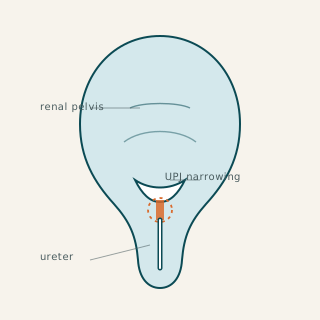
Pelvi-ureteric junction (UPJ) obstruction is a narrowing where the kidney's collecting system joins the ureter. When drainage is blocked the kidney stretches, pain follows, and function can decline. Pyeloplasty is the operation that removes the narrow segment and reconstructs a wide, watertight join. Dr Raji Kooner performs robotic, laparoscopic, open, and laser endoscopic repairs, and has published on robotic pyeloplasty nationally and internationally.
Approaches
Each approach removes or bypasses the narrow segment at the top of the ureter. They differ in invasiveness, recovery time, and long-term success. The right choice depends on the anatomy, how much the kidney has been affected, and patient preference.
Gold-standard minimally invasive reconstruction. 3D vision, articulated instruments, and a fourth robotic arm for bowel retraction. ~95% long-term success.
Read about robotic repairKeyhole reconstruction using straight instruments. Effective but technically demanding because instrument tips do not rotate like the robot's.
Read about laparoscopic repairTraditional flank incision approach. Reserved for selected situations where keyhole access is not suitable. 7 to 10 days in hospital and a longer recovery.
Read about open repairRetrograde endoscopic option through the urethra. Holmium laser incises the narrowing; a stent is left in for six weeks. Lower success than surgery but avoids any incision.
Read about endopyelotomyA CT urogram shows the anatomy of the renal pelvis and ureter, and a diuretic MAG3 renogram measures how well each kidney drains when a diuretic is given. Together they confirm obstruction and quantify the affected kidney's function.
Robotic pyeloplasty is the preferred first-line reconstruction for most adults. Laparoscopic and open approaches still have selected roles. Laser endopyelotomy suits shorter narrowings and patients who have failed previous treatment. The choice is discussed at consultation using your imaging.
After reconstruction, a temporary internal ureteric stent protects the join for four to six weeks; stent removal is a brief day-case procedure. A follow-up MAG3 at three to six months confirms the repair is draining normally.

About the surgeon
Dr Kooner is a urological surgeon with a long-standing interest in minimally invasive reconstructive kidney surgery. He has performed robotic-assisted laparoscopic pyeloplasty at St Vincent's Private Hospital since the early days of robotic urology in NSW, including pioneering use of the fourth robotic arm for bowel retraction. His case series - Robotically-assisted laparoscopic pyeloplasty (RALP): utilisation of the robotic 4th arm in dismembered pyeloplasty - a review of the first 9 cases in NSW (Al-Sameraaii, Raman, Yuen, Kooner) - has been presented nationally and internationally.
Clinical care is coordinated through Urology NSW. This satellite site groups pyeloplasty-specific information in one place.
In most patients, yes. Relieving the obstruction lets the kidney drain normally and prevents further decline in function. Kidneys that have already lost most of their function may be counselled about alternatives, including doing nothing or, rarely, removal.
Published success rates for robotic pyeloplasty are above 95%, and Dr Kooner's own series has shown complete relief of obstruction in all patients treated. A follow-up scan or renogram at three to six months confirms drainage; longer-term recurrence is uncommon.
Laser endopyelotomy is a non-reconstructive option performed through the urethra. Success rates are around 75% and it suits shorter narrowings or patients who want to avoid incisions. For most patients with confirmed obstruction and reasonable kidney function, surgical reconstruction is preferred.
Suite 1303, Level 13, St Vincent's Private Hospital
406 Victoria Street, Darlinghurst NSW 2010
Suite 1.12, Level 1
3-9 Gillies Street, North Sydney NSW 2060
Suite 9, 70 Bowral Street
Bowral NSW 2576
The rooms can arrange a consultation to review imaging, confirm obstruction with a drainage study, and outline which pyeloplasty approach fits your situation.